Project Overview: Manufacturing Plant — Johns Manville TPO Overlay + Re-Roof (Montgomery, IL)
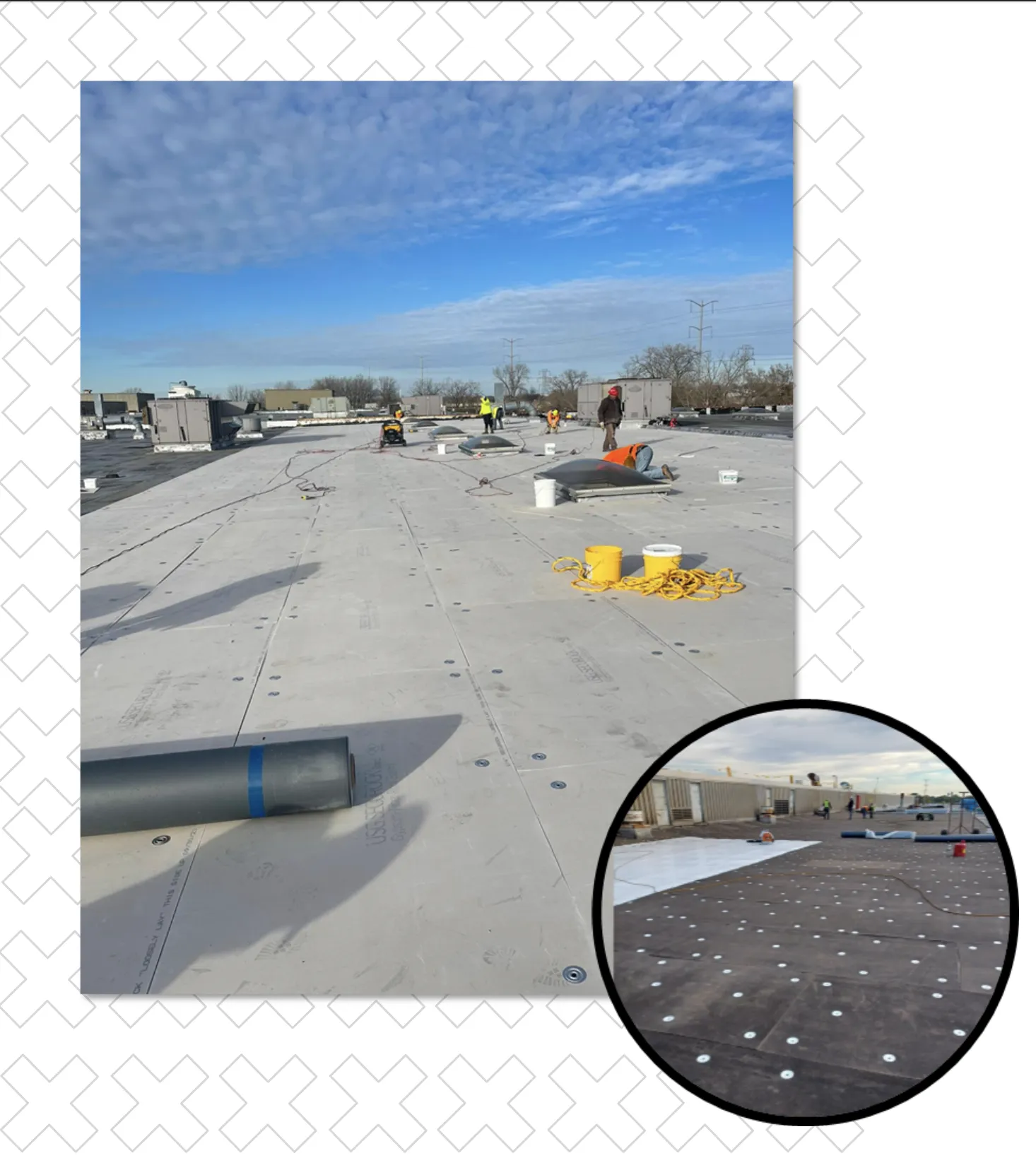
This manufacturing facility project in Montgomery, Illinois involved a large-scale low-slope scope totaling
1,000,000 sq. ft. Our team completed a 9,200-square overlay and an additional
800-square re-roof using a Johns Manville TPO system. The priority was controlled logistics,
consistent detail work, and a watertight assembly built to perform on a high-demand industrial roof.
Assessment & Scope Planning
With industrial roofing, the details and sequencing matter just as much as the membrane. We reviewed the existing conditions,
confirmed the overlay and re-roof areas, and planned the job for safe movement, clean staging, and consistent installation
across a massive footprint. Key focus areas included water flow, drain performance, penetrations, transitions, and edge
conditions—because those are where long-term leaks start.
The process below reflects a system-first approach designed to protect operations and deliver a dependable, watertight TPO roof.
- Field review to confirm overlay vs. re-roof areas and the existing roof’s condition.
- Drainage and ponding-risk checks at drains, scuppers, and low points.
- Detail planning for penetrations, curbs, walls, and terminations to reduce future maintenance.
- Phasing and jobsite controls to keep production areas protected and the roof work orderly.
Why Detail-Forward TPO Work Matters on Industrial Facilities
On manufacturing plants, the roof has one job: protect the facility—every day, in every season. A TPO roof’s reliability is won
at seams, terminations, penetrations, and transitions. When the roof is built consistently and inspected through each phase,
you get fewer surprises, fewer disruptions, and more confidence in the building envelope.
- Consistent seam work and transitions for strong, watertight performance.
- Controlled terminations and edge details to help resist wind uplift and movement.
- Clean staging and safety-first execution to protect people, equipment, and operations.
- Clear communication and documentation to keep stakeholders aligned throughout the job.
Results & Takeaways
This project delivered a clean, professionally executed Johns Manville TPO system across a major facility footprint—balancing
speed, safety, and quality control. By keeping the work controlled and detail-driven, the roof is positioned for reliable
performance and reduced risk at the most failure-prone areas (drainage, penetrations, transitions, and edges).
The key takeaway: large roofs demand repeatable standards. When every seam, termination, and transition is built with the same
level of discipline, the system performs like one continuous watertight assembly—exactly what industrial facilities require.


